
Starting a poultry business sounds simple, but it needs careful planning. It also needs the right equipment and a clear view of daily farm work. Many new investors ask a common question: how can I start a poultry farm and avoid costly mistakes?
The truth is, success in poultry farming is not only about buying chickens. It depends on farm design, housing, and choosing the right broiler farming equipment that can support long-term production.
Step 1: Choose a Suitable Farm Location
Before building anything, the location must be carefully selected. A good poultry farm should be far from homes. It should have steady electricity, clean water, and easy transport access.
Environmental factors also matter. Good airflow and a dry environment will reduce disease risk and improve chicken growth.
Step 2: Plan Your Chicken House Design
The next step is understanding how to build chicken houses that can support commercial broiler production.
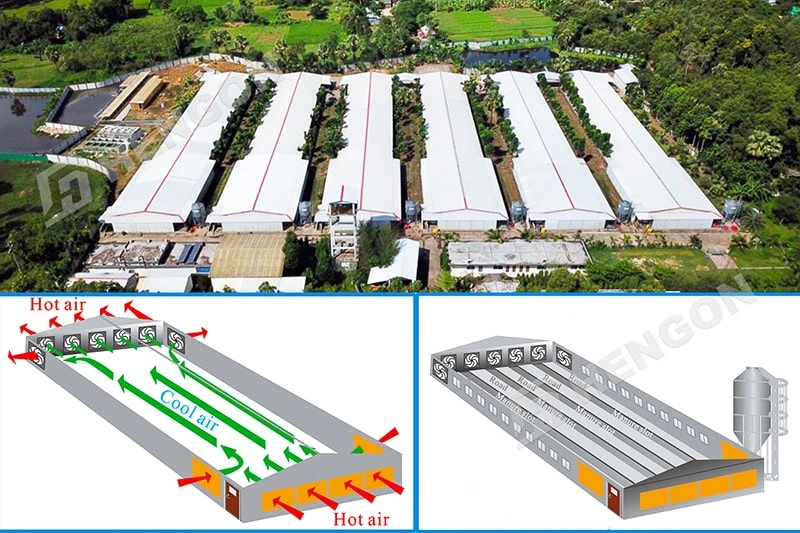
A modern farm often uses a steel broiler chicken house because it is strong, durable, and fits many climates. Inside the house, designers must allocate space for feeding lines, drinking systems, ventilation fans, and manure management.
A well-planned meat chicken shelter keeps a steady temperature and lowers stress for chickens. This directly improves their growth performance.
Step 3: Choose the Right Broiler Farming Equipment
Equipment is the core of modern poultry farming. Without proper systems, managing a large number of chickens becomes difficult and inefficient.
Key broiler chicken farming equipment includes:
· Automatic feeding system
· Nipple drinking system
· Ventilation fans and cooling pads
· Heating system (for cold areas)
· Environmental control system
· Manure removal system
These systems work together to create a stable environment. They also reduce manual labor and help farmers manage thousands of chickens more easily.
Step 4: Understand Modern Poultry Farming Equipment
Today’s farms rely heavily on modern poultry farming equipment to improve efficiency.
Instead of manual feeding and water distribution, automated systems ensure every chicken gets equal access to feed and water. This improves uniform growth and reduces waste.
Farmers also use sensors and control panels to monitor temperature and humidity. This helps avoid sudden environmental changes that could harm the flock.
Step 5: Consider Automation and Battery Farming
Some commercial farms also use battery farming systems, especially for large-scale production.
Battery systems help save space and improve management efficiency. Combined with automated poultry equipment, they allow farmers to control large flocks with less labor.
This is especially useful for investors who want to scale their poultry business quickly.
Step 6: Work with a Reliable Supplier
One of the most important decisions is choosing a professional supplier. A good company will not only provide equipment but also support farm design, installation, and operation guidance.
A complete solution reduces risk and helps beginners avoid common mistakes when starting a poultry farm.
Final Thoughts
If you are serious about joining the poultry industry, the key is not just learning how to start a farm. Building a system that can run well for years is also important.
With good planning, a strong chicken house, and reliable broiler farming equipment, poultry farming can be stable and profitable.
Contact Us
If you plan to start a poultry farm and need equipment, chicken house design, or full farm solutions, we can help.
Email: consultant7@hglsgroup.com
Phone: 0086-19398195396
Website: www.hengongroup.com
 English
 Español
 Français


